Archives


Who Are the Top Thermal Printer Paper Suppliers in China?

Choosing a Thermal Printer Paper supplier in China takes more than comparing prices. Buyers need paper that feeds smoothly, prints clearly, and holds up during storage and handling. A roll may look fine on a sample table, yet perform differently in a busy checkout lane. Small details matter: paper width, roll length, core size, coating, and packaging.

This guide explores how to assess suppliers, not simply rank them. It considers product range, production capability, quality checks, customization, and communication. Ask for samples and confirm specifications before discussing large orders. Check whether the supplier can explain its coating options and describe how it manages consistency between batches. Clear answers are useful. Vague promises are not.

Supplier claims still deserve careful review. A polished website does not prove reliable production, and the lowest quote may leave out important details. Compare written specifications, sample performance, lead times, and after-sales support. Where available, review relevant certifications and request documentation rather than relying on logos alone. There is no perfect checklist. Some buyers may prioritize print clarity, while others need dependable delivery or custom roll sizes. This overview offers practical questions for identifying a suitable partner, while recognizing that verification takes time and a little healthy skepticism.
Who Are the Top Thermal Printer Paper Suppliers in China?

Thermal Printer Paper: Products, Grades, and Common Uses

Thermal printer paper from China is not a single product. Reliable suppliers usually offer rolls, sheets, fanfold paper, labels, and coated tickets. Each format matches a different machine. A 57 mm receipt roll suits compact counters, while 80 mm rolls fit many retail terminals. Width, core diameter, roll length, and winding direction should be checked before ordering.

Grades matter more than a bright white surface. Standard economy paper works for short-lived receipts and queue numbers. Premium paper uses a more stable coating for clearer printing and better resistance to heat, light, moisture, and oil. For shipping labels, direct thermal stock needs suitable adhesive and a smooth face. Some applications require BPA-free or phenol-free grades, depending on local requirements and buyer policies. Material declarations and test samples show a supplier’s reliability.

Common uses include retail receipts, restaurant orders, parking tickets, medical queue slips, warehouse labels, and transport records. In my testing experience, poor storage can ruin good paper. Rolls left beside a hot window may fade quickly. This point is easy to miss. Supplier claims need verification through print tests, aging checks, and measurements from actual printers. I would not judge quality from a catalog photograph alone. A slightly uneven edge or weak core can cause jams, waste, and frustrated operators.

China’s Thermal Paper Supply Chain and Manufacturing Landscape

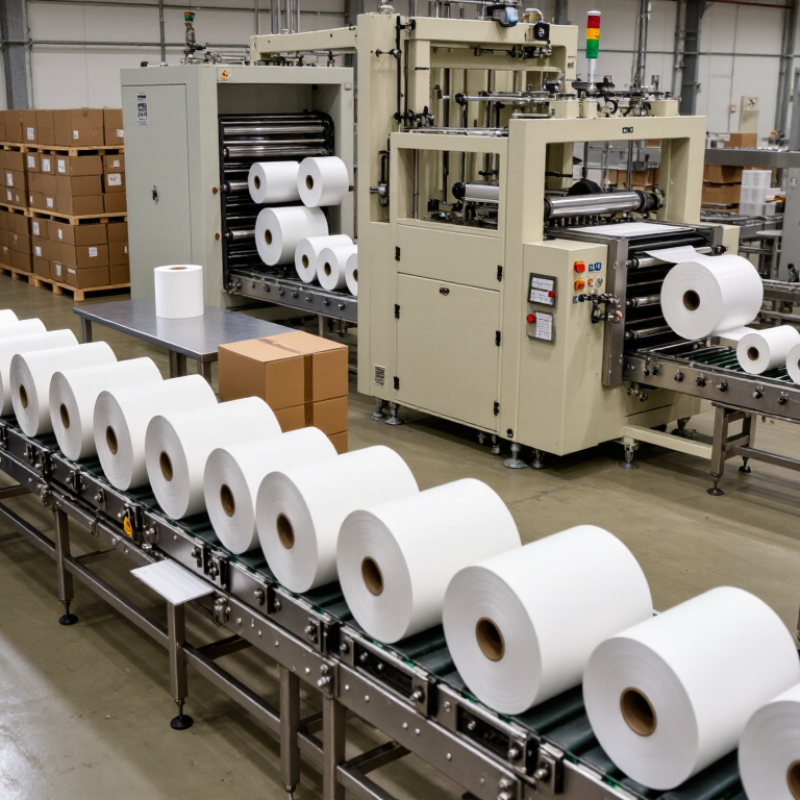
China’s thermal paper supply chain connects pulp importers, coating mills, paper converters, and export distributors. The strongest suppliers usually manage several stages internally. This improves consistency and shortens delivery times. Some manufacturers produce jumbo rolls, while others cut them into receipt rolls, labels, or tickets. Their factories often include coating lines, slitting machines, rewinding equipment, and dust-controlled packing areas.

Reliable suppliers control the coating formula carefully. They test image density, heat sensitivity, smoothness, and storage stability. Production teams may check roll width with digital gauges and inspect finished rolls under strong light. Moisture-resistant packaging matters during long sea shipments. A crushed carton can damage otherwise acceptable paper. Experienced buyers should request samples from different production batches, not just one attractive shipment.

The leading suppliers are not always the cheapest. They may offer clearer specifications, stable lead times, and better responses to quality claims. Ask about paper thickness, core size, roll length, packaging, and applicable safety documentation. Traceability is useful when a customer reports fading or printer jams. Still, supplier information is not always perfectly transparent. Factory capacity can change during peak seasons. Even experienced purchasers can overlook small differences in coating performance. Regular testing remains necessary, especially for paper used in humid stores, outdoor kiosks, or high-volume checkout counters.

Leading Thermal Printer Paper Suppliers in China

Leading thermal printer paper suppliers in China serve retail, logistics, healthcare, and food-service businesses. Strong suppliers offer consistent coating, dependable roll dimensions, and clear documentation. These details affect print contrast and printer performance. A roll that looks suitable may still produce faint text or leave excess dust. Small differences matter.

When evaluating a supplier, ask for samples from the grade you plan to purchase. Print barcodes, fine text, and shaded areas, then check whether they remain legible after handling. Ask about paper weight, roll width, core size, coating uniformity, and packaging. Request recent quality inspection records, too. A polished specification sheet is useful, but it cannot replace a real test. Test it.

Reliable communication is another useful signal. Suppliers should explain production capacity, lead times, and how they handle inconsistent batches. Confirm whether packaging protects rolls from moisture and crushed edges during shipping. For recurring orders, compare samples from different production runs instead of assuming every batch will match. This takes extra time. Still, buyers sometimes focus too much on price and overlook storage conditions or printer compatibility. That is an easy mistake, and one worth reviewing before placing a large order.

Top Thermal Printer Paper Suppliers in China: Common Product Specifications

Comparison of widely requested thermal paper grades supplied for POS, kiosk, ATM, and label applications.

Thermal paper is commonly specified by basis weight. Standard POS rolls are often produced around 48–55 GSM, while kiosk, ATM, and label applications generally require heavier 65–80 GSM stock for improved durability and handling.

How to Compare Chinese Suppliers by Quality and Certifications

Comparing Chinese thermal paper suppliers requires more than checking price lists. Start with measurable specifications: paper weight, thickness, roll width, core size, and thermal sensitivity. Request samples from the same production batch. Print identical receipts on each roll. Check darkness, edge sharpness, fading, curling, and loose dust after repeated handling. Store samples in a warm, humid room for several days. This simple test often reveals differences that certificates cannot show. Not every low-cost roll is poor.

Ask suppliers for current certificates, issuing bodies, certificate scope, and expiry dates. ISO 9001 can indicate a controlled quality system, but it does not guarantee every roll is perfect. For chemical compliance, request recent laboratory reports covering relevant restricted substances, plus a batch-specific certificate of analysis. Verify that the factory name and product description match. A scanned document is only a starting point. Confirm traceability from coating materials to finished cartons. Independent audits add useful evidence, especially when records seem vague.

Reliable suppliers explain coating formulas, storage conditions, and inspection limits without avoiding technical questions. Compare their moisture controls, roll-winding accuracy, packaging strength, and response time for defective goods. Ask how they handle a failed batch. Their answer matters. During one comparison, I focused too heavily on print darkness and overlooked adhesive residue on labels. That mistake changed my checklist. Record test results beside each supplier’s documents, because buyer testing remains necessary.

Who Are the Top Thermal Printer Paper Suppliers in China? - How to Compare Chinese Suppliers by Quality and Certifications

Comparison Factor What to Check Useful Evidence How to Compare Suppliers
Thermal paper grade Confirm the paper is intended for the printer type and application, such as POS receipts, labels, or tickets. Product specification sheet showing basis weight, thickness, roll dimensions, and coating details. Compare specifications against your printer requirements and the same intended use; do not rely on a general “premium” description.
Image performance Assess print density, image clarity, and resistance to fading under the storage and handling conditions expected. Samples printed on your equipment, plus test results that identify the test method and conditions. Run samples using the same printer settings and compare legibility after a defined storage or exposure period.
Paper and roll consistency Check for even coating, clean slitting, secure winding, and consistent roll dimensions. Inspection records, dimensional tolerances, and samples from more than one production lot. Compare multiple lots for variation, not just a single pre-production sample.
Substances of concern Specify any restricted-substance requirements, including whether BPA or BPS must be absent or below a stated limit. Current test reports from a qualified laboratory, tied to the exact paper grade and manufacturing site. Check the report’s scope, date, methods, and sample identification. “BPA-free” alone does not establish that other substances are absent.
ISO 9001 quality management Verify whether the manufacturing site operates under a certified quality management system. Valid ISO 9001 certificate showing the certificate holder, site, scope, certification body, and validity dates. Confirm the certificate with its issuer or accreditation directory and make sure the listed scope covers relevant production activities.
Environmental and forestry claims Check whether claims such as recycled content or responsibly sourced fiber are relevant to your purchasing requirements. Applicable chain-of-custody certificate and product documentation; verify that the specific product is covered. Do not treat a company-level certificate as proof that every product carries the same certification claim.
Regulatory documentation Identify the laws and market requirements that apply to the destination country and product use. Product-specific declarations, test reports, and supporting technical documents requested for the target market. Check that documents match the product grade, intended use, and destination market; requirements can differ by jurisdiction.
Traceability and change control Ask how the supplier identifies production lots and communicates changes to raw materials or processes. Lot codes, batch records, written change-notification procedures, and a sample nonconformance process. Compare how quickly each supplier can trace a delivered roll to its production batch and provide supporting records.
Sampling and pre-shipment inspection Agree on sample approval, inspection criteria, and how defects are handled before production and shipment. Approved sample, written inspection checklist, inspection report, and corrective-action process. Use the same written acceptance criteria for all shortlisted suppliers and retain an approved reference sample.
Packaging and transport protection Review packaging for protection against moisture, dust, crushing, and handling damage during transit. Packaging specification, carton markings, and photographs or samples of export packaging. Compare packaging against the shipping route, storage environment, and requirements for roll cleanliness and condition.

This table is a supplier-evaluation checklist, not a ranking or verification of individual manufacturers. Request current, product-specific documents and independently confirm certificates and test reports before placing an order.

Key Factors for Sourcing Thermal Printer Paper from China

Choosing a thermal paper supplier in China starts with the printer, not the quotation. Confirm roll width, core diameter, winding direction, and paper weight against your device specifications. Even a small mismatch can cause feeding problems. Ask about coating uniformity and print darkness, especially if receipts must remain legible after handling. Test it first. Print sample rolls on your own equipment, then check for smudging, fading, and dust around the print head. A bright sample alone does not prove consistent production quality.

Compare suppliers using the same written specification. Request details on roll dimensions, packaging, batch identification, and inspection procedures. Ask how production lots are checked for thickness and coating defects, and whether samples can be matched to later orders. Storage matters, too: heat, sunlight, and humidity can shorten image life. Discuss sealed packaging and realistic shipping lead times, rather than relying on an optimistic estimate. Communication quality is useful evidence, but it is not a substitute for testing. One weakness in this process is that sample rolls may come from a carefully selected batch. For larger orders, consider a pre-shipment inspection and keep an approved sample for comparison. Specify acceptable variations in writing before production begins.

Close
Enter your email address to receive special offers!
linkedin facebook pinterest youtube rss twitter instagram facebook-blank rss-blank linkedin-blank pinterest youtube twitter instagram