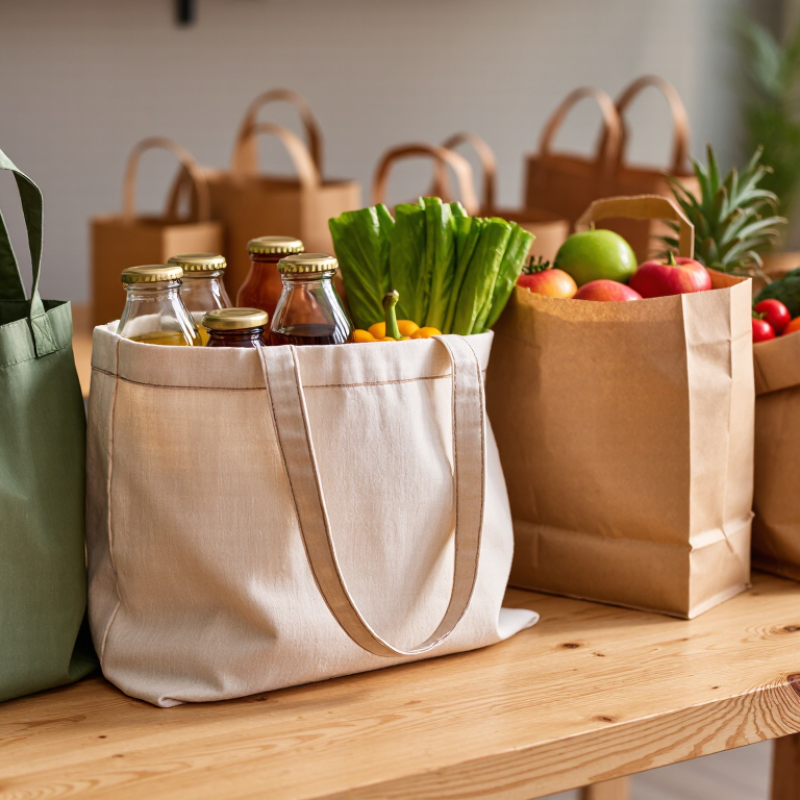
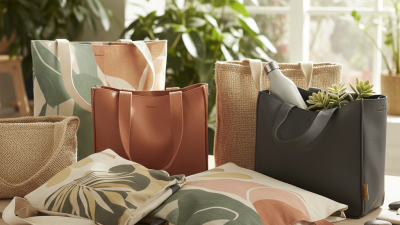
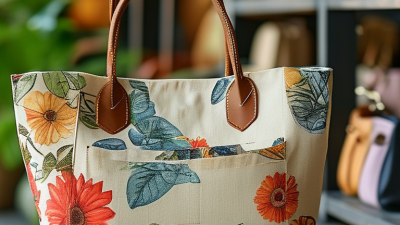
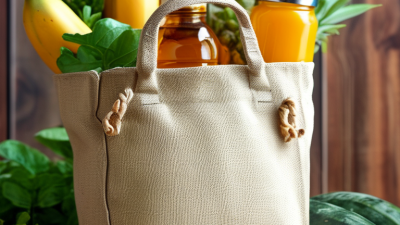
Recycled Paper Bag
Post-consumer or post-industrial recycled kraft paper |
32 × 12 × 25 cm
Approx. 5–8 kg load, depending on paper weight and handle construction |
Usually single-use or limited reuse in dry conditions. Reuse improves when the bag has a reinforced base and twisted-paper handles. |
$0.08–$0.35 |
3,000–10,000 pieces |
Widely recyclable
Low plastic content
Moisture resistance may require coatings that affect recycling. Ask for recycled-fiber percentage and coating details.
|
Recycled-content declaration, paper specification, ink and coating information, supplier quality inspection report |
Paper packaging is generally subject to local packaging-waste rules. Some markets require recycled-content claims to be supported by traceable records. Verify food-contact compliance if the bag touches unpackaged food. |
Retail checkout, bookstores, takeaway products, events and promotional distribution |
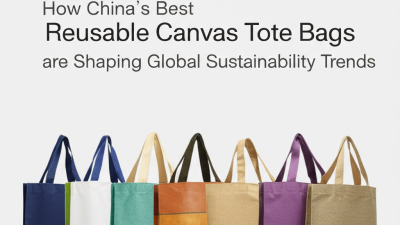
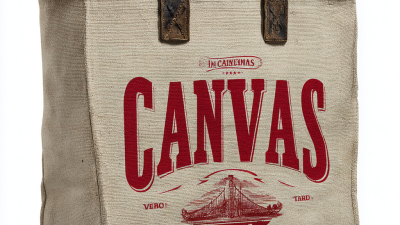
Cotton Tote Bag
Conventional or organic cotton canvas |
38 × 10 × 42 cm
Approx. 8–12 kg load for medium-weight canvas |
Designed for repeated use. A practical sustainability comparison should consider the number of uses needed to offset higher production impacts than lightweight paper. |
$0.75–$3.50 |
500–3,000 pieces |
Durable
Reusable
Cotton cultivation can require significant water and agricultural inputs. Organic claims should be supported by recognized chain-of-custody certification.
|
Fiber-content label, weight and construction specification, colorfastness test, organic certification where claimed |
Textile labeling rules may require fiber composition, country of origin and care information. Chemicals used in dyes, prints and finishes may be restricted under destination-market chemical regulations. |
Grocery shopping, fashion retail, conferences, libraries and long-term promotional use |
Recycled PET Non-Woven Bag
Polyester made from recycled plastic bottles or other recycled feedstock |
38 × 10 × 42 cm
Approx. 8–15 kg load, depending on GSM and stitching |
Reusable for repeated dry-goods shopping. Service life depends on fabric weight, handle strength and seam quality. |
$0.18–$0.80 |
1,000–5,000 pieces |
Uses recycled polymer
Lightweight
It remains a synthetic textile and is not normally biodegradable. Recycled-content claims need supporting mass-balance or transaction records.
|
Recycled-content certificate or declaration, fabric GSM report, tensile and seam-strength test, restricted-substance test |
Some jurisdictions regulate plastic products and require producer-responsibility registration or packaging reporting. Confirm whether the product is classified as packaging, a textile article or both. |
Supermarkets, retail chains, trade shows, promotional campaigns and general merchandise |
Polypropylene Woven Bag
Reusable woven PP fabric |
40 × 15 × 45 cm
Approx. 10–20 kg load when properly stitched |
Multiple-use shopping bag. Woven construction generally provides better tear resistance than thin non-woven fabric. |
$0.30–$1.20 |
1,000–5,000 pieces |
Long service life
Low unit weight
Made from fossil-based plastic and normally requires separate recycling pathways. Avoid unsupported claims such as “biodegradable.”
|
Polymer identification, fabric GSM, load test, handle and seam test, restricted-substance report |
Plastic-bag restrictions differ substantially by country and sometimes by region or municipality. Check thickness thresholds, reusable-bag definitions, labeling and fee requirements before shipment. |
Bulk grocery purchases, household goods, agricultural retail and warehouse-style stores |
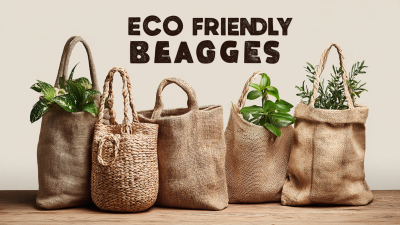
Jute or Bast-Fiber Bag
Natural jute, kenaf or similar plant fiber |
38 × 12 × 42 cm
Approx. 8–15 kg load, depending on weave and lining |
Reusable for dry products. Natural fibers can lose strength when exposed to prolonged moisture. |
$0.60–$2.50 |
500–3,000 pieces |
Renewable fiber
Biobased appearance
Natural-fiber products may require pest treatment or phytosanitary controls. Laminations and synthetic linings reduce end-of-life recyclability.
|
Fiber composition, moisture and mold inspection, treatment certificate where applicable, restricted-substance test for dyes and coatings |
Plant-based materials may trigger agriculture, quarantine or wood-and-plant-product controls. Importers should verify whether a phytosanitary certificate, treatment record or additional inspection is required. |
Specialty food retailers, gift packaging, agricultural products and premium reusable shopping programs |
Organic Cotton Bag
Certified organic cotton canvas or calico |
38 × 10 × 42 cm
Approx. 8–12 kg load |
Suitable for repeated use when washed and stored correctly. Durability depends on fabric weight and construction. |
$1.00–$4.50 |
500–2,500 pieces |
Certified fiber option
Reusable
“Organic” refers to the fiber-production claim, not automatically to the dye, print, sewing process or complete product.
|
Valid organic transaction certificate or equivalent supply-chain evidence, fiber-content label, colorfastness and restricted-substance tests |
Organic claims must be traceable and should not be used when only a small portion of the product is certified. Textile labeling and chemical rules still apply to the finished bag. |
Premium retail, sustainable events, subscription boxes and buyers requiring documented organic inputs |
Paper Bag with Water-Based Coating
Recyclable kraft paper with aqueous finish |
26 × 14 × 32 cm
Approx. 3–6 kg load |
Normally intended for short-term use. Aqueous coatings may improve scuff and moisture resistance but do not make the bag waterproof. |
$0.10–$0.45 |
3,000–10,000 pieces |
Paper-based
Print-friendly
Ask recyclers or local authorities whether the specific coating, adhesive and handle combination is accepted in the destination recycling stream.
|
Paper GSM, coating specification, ink and adhesive declaration, recycled-content evidence where claimed |
Packaging labeling, recycling symbols and environmental claims must follow destination-market rules. Avoid “100% recyclable” unless the complete product is accepted by relevant local systems. |
Restaurants, bakeries, pharmacies, apparel stores and short-distance retail distribution |
Compostable Biopolymer Bag
Certified compostable film or non-woven structure |
35 × 10 × 40 cm
Approx. 5–10 kg load |
Designed for specific composting conditions rather than unlimited reuse. Performance may decline with heat, humidity, oils or extended storage. |
$0.20–$1.00 |
5,000–20,000 pieces |
Condition-specific disposal
Not automatically biodegradable in nature
Industrial-compostability claims require appropriate certification. Compostable products can contaminate conventional plastic recycling if incorrectly sorted.
|
Compostability certificate, polymer composition, shelf-life data, thickness and tensile-strength test, approved disposal instructions |
Many markets restrict or tightly control “compostable,” “biodegradable” and “plastic-free” claims. Importers must confirm accepted standards, labeling language and waste-management availability. |
Organic-waste collection programs, selected food-service applications and markets with suitable composting infrastructure |